
A sunroom in summer can go from your favorite room in the house to the hottest one in a matter of hours. All that beautiful glass that floods the space with natural light also traps solar heat—and without the right cooling strategy, interior temperatures can climb 20-30 degrees above outdoor air temperature on a sunny afternoon.
The good news? Sunroom cooling is a solvable problem. The key is understanding where the heat comes from and addressing it at the right point. Here’s a breakdown of the most effective solutions, ranked by impact.
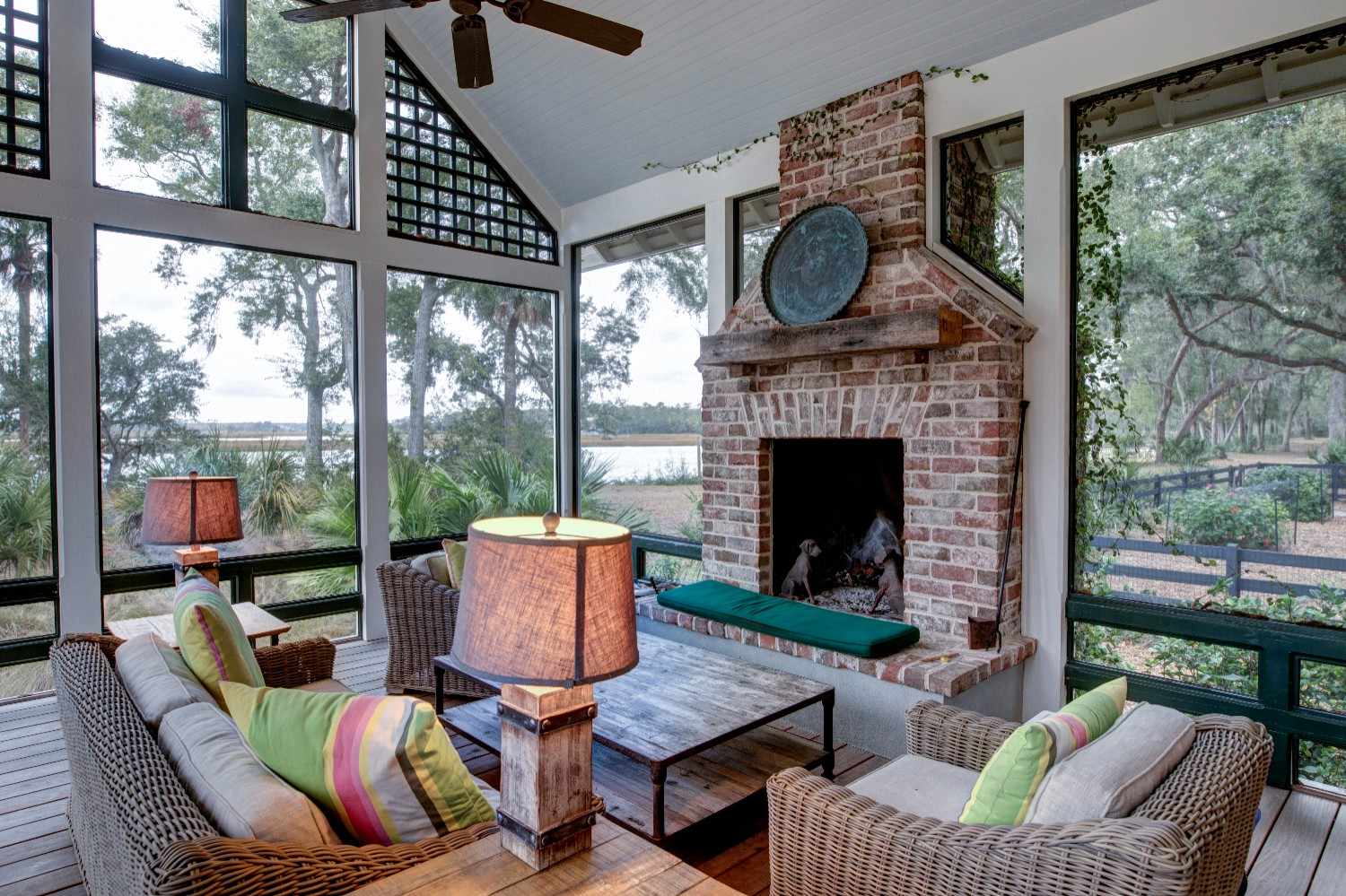
Why Sunrooms Get So Hot
The same mechanism that heats a greenhouse heats your sunroom. Glass is highly transparent to shortwave solar radiation—visible light and near-infrared—allowing it to pass through and be absorbed by your floors, furniture, and walls. Those surfaces then re-emit the energy as longwave thermal infrared radiation. But glass is effectively opaque to longwave infrared, trapping that heat inside rather than letting it escape. Add in the physical containment of heated air, and temperatures rise quickly.
Two factors make the problem worse:
Solar Heat Gain Coefficient (SHGC) measures how much solar heat your glass admits, on a scale from 0 to 1. Lower is cooler. In hot or cooling-dominant climates, glazing with an SHGC below 0.25 is recommended. Many standard sunrooms ship with SHGC values of 0.40 or higher—admitting nearly twice the solar heat they should.
Roof glazing amplifies the problem. Overhead glass receives direct solar impingement at a steep angle during summer when the sun is high, increasing the rate of heat transmission. A sunroom with a glass roof will overheat more severely than one with only vertical glass walls, even with identical glass specifications.
Ductless Mini-Splits — The Most Effective Mechanical Solution
A ductless mini-split is the top recommendation from HVAC professionals for sunroom cooling, and for good reason. It provides independent temperature control without burdening your home’s central system—which was never sized to handle the extreme heat loads of a glass-enclosed room.
Sizing matters. A standard well-insulated room needs roughly 20-25 BTU per square foot of cooling capacity. A sunroom needs significantly more:
| Sunroom Type | BTU per Square Foot |
| Well-insulated four-season sunroom | 25-30 BTU/sq ft |
| Three-season or poorly insulated sunroom | 30-60 BTU/sq ft |
A 200-square-foot three-season sunroom may need a 12,000 BTU unit. High sun exposure or poor insulation? Add another 4,000-6,000 BTU to the baseline.
Don’t oversize. A unit that’s too large will short-cycle—reaching the set temperature so quickly that it never runs long enough to remove humidity. The result is a room that feels cool but clammy. Proper sizing based on a Manual J heat load calculation is essential.
Modern mini-splits with SEER2 ratings of 20 or higher deliver excellent efficiency. Installation typically runs $2,000-$7,000 depending on unit size and complexity.
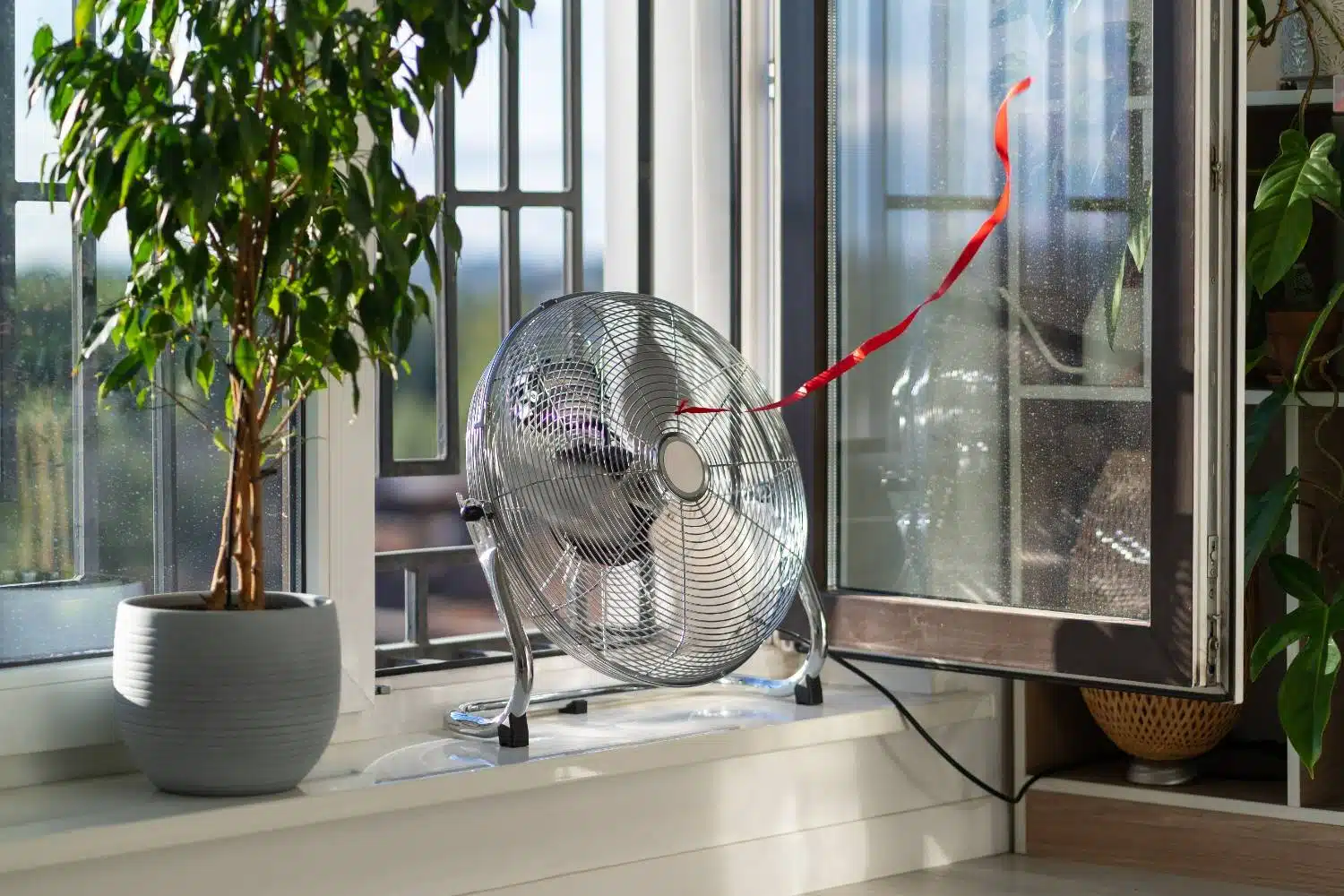
Exterior Shading — Block Heat Before It Enters
This is the single most important principle in sunroom cooling: stop solar heat before it passes through the glass.
The physics strongly favors exterior shading over interior. A DOE-documented comparison found that a south-facing room reaching 97°F with no coverings dropped to only 90°F with an interior screen—but to 75°F when an external screen was used, without any air conditioning. The difference is dramatic because exterior shading intercepts solar radiation before it converts to trapped infrared heat inside.
Exterior awnings reduce solar heat gain by up to 65% on south-facing windows and up to 77% on west-facing windows, according to DOE data. Retractable awnings offer the added flexibility of allowing passive solar gain in winter when you want the warmth—a meaningful advantage in mixed climates.
Shade trees are the most cost-effective long-term solution. A medium-sized deciduous tree can reduce solar radiation hitting a south-facing wall by approximately 80% when in leaf, while allowing winter sun through when bare. Research from the International Society of Arboriculture found that three strategically placed trees reduced annual cooling energy use by 10-50% and peak electrical demand by up to 23%.
Window Film — A Cost-Effective Upgrade
Solar control window film applied to existing glass is one of the most practical upgrades for an overheating sunroom. High-performance nano-ceramic films reject 50-80% of solar heat while maintaining 50-78% visible light transmission—keeping your sunroom bright without the oven effect.
One important distinction: Low-E coatings and solar control film are not the same thing. Low-E primarily reduces conductive heat transfer (improving U-value), while solar control glass or film specifically lowers SHGC. A window can have a good U-value for winter insulation but still admit excessive solar heat in summer. For sunroom cooling, SHGC is the specification that matters most.
Professional window film installation typically costs $8-18 per square foot. For a 200-square-foot sunroom with 300 square feet of glass surface, expect $2,400-$5,400—significantly less than replacing the glass entirely.
Interior Shading — Helpful, but Not a Primary Solution
Interior blinds and shades reduce heat, but because they allow solar radiation through the glass before attempting to block it, they’re less effective than exterior solutions.
Cellular honeycomb shades are the best-performing interior option. Properly fitted with tight side channels, they can reduce unwanted solar heat gain by up to 60%, according to DOE data. The air pockets in the honeycomb cells act as insulation, providing a dual benefit in both summer and winter. An ORNL (Oak Ridge National Laboratory) study measured daily heating energy savings of 17-36% with cellular shades—making them a year-round investment.
Reflective blinds (white or near-white, fully closed with the reflective surface facing the glass) reduce solar heat gain by approximately 45%. Standard non-reflective blinds perform meaningfully less.
Interior shading works best as a supplement to exterior shading, window film, or mechanical cooling—not as a standalone strategy for a high-solar-gain sunroom.
Ventilation — Work with the Stack Effect
Hot air rises. In a sunroom, using that principle deliberately can flush accumulated heat without running a compressor.
The stack effect works by pairing low-level air inlets (operable windows near the floor) with high-level outlets (operable skylights, ridge vents, or exhaust fans at the ceiling). Cool air enters low, warm air exits high, and the greater the vertical distance between inlet and outlet, the stronger the natural airflow.
This strategy is most effective in climates with significant day-night temperature swings. Opening skylights and low windows in the evening can flush a day’s worth of accumulated heat in a matter of minutes. In humid climates where nighttime temperatures stay high, the benefit is more limited.
A ceiling fan running at low speed helps distribute air and can make a space feel up to 4°F cooler through wind-chill effect, according to DOE data. The DOE also notes that using fans with AC allows raising the thermostat by 4°F without a comfort penalty—saving meaningful energy. Just remember: fans cool people, not rooms. They don’t lower air temperature, so turn them off when the room is empty.
The Roof Is Often the Biggest Problem
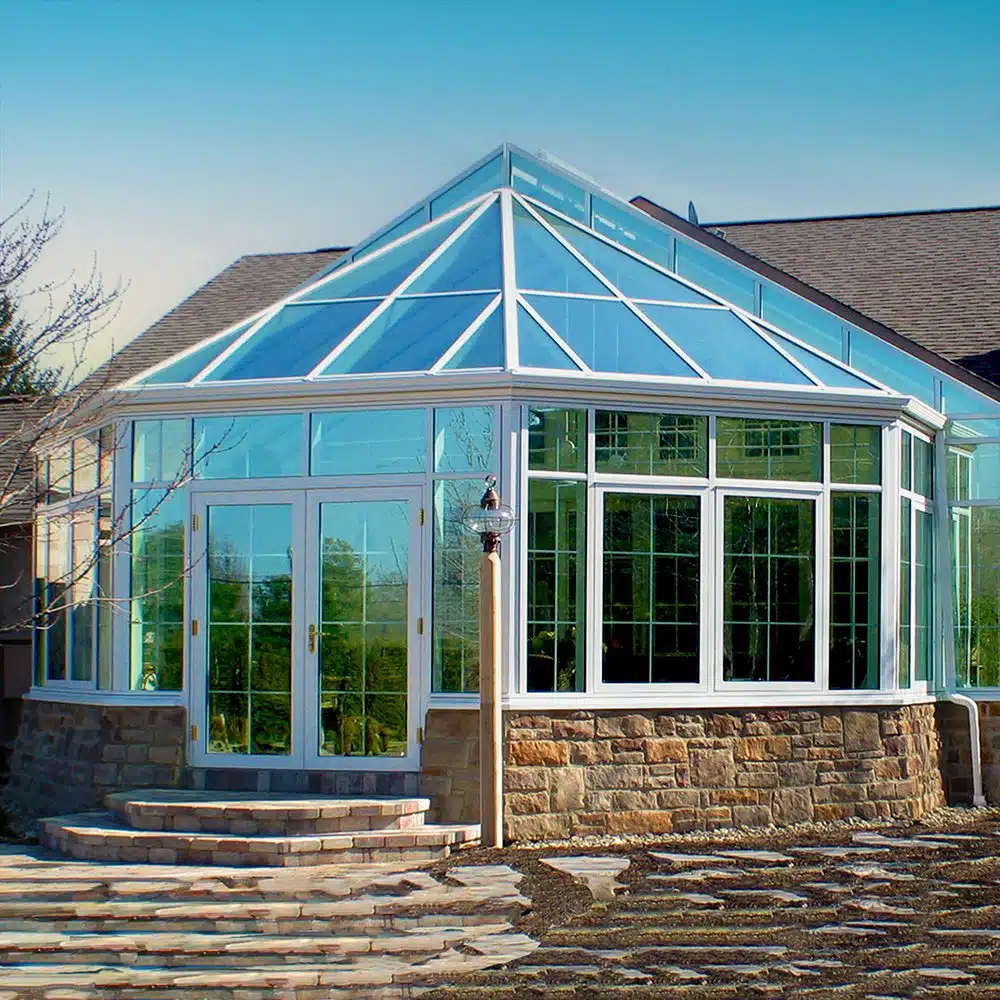
If your sunroom has a glass or polycarbonate roof, overhead heat gain likely exceeds the gain through all vertical walls combined during summer. The sun is nearly directly overhead, driving maximum solar transmission through the roof plane.
The performance gap is enormous. A glass roof delivers R-2 to R-3 of insulation. An insulated solid panel roof delivers R-20 to R-38—roughly 10-15 times better thermal resistance. Replacing a glass roof with insulated panels eliminates overhead solar gain entirely, but at the cost of the open-sky feel that defines many sunrooms.
Compromise approaches: Solar control glazing on roof panels, retractable roof shades, insulated polycarbonate (which still transmits diffused light), or a partial solid/partial glass roof design that balances light with thermal performance.
If you’re applying window film or shading, start with the roof—it’s where the most heat enters.
Common Cooling Mistakes to Avoid
Extending your home’s central HVAC. The main system is sized for insulated rooms, not glass-enclosed spaces with 2-3 times the heat load per square foot. Connecting a sunroom typically overwhelms the system, overcools the rest of the house, and drives up energy costs.
Using a single-hose portable AC. These units create negative pressure, pulling warm air in through gaps to replace what they exhaust. Two-hose portable units, window units, or mini-splits are all significantly more effective.
Ignoring the roof while treating the walls. Applying film or blinds to vertical glass while leaving an untreated glass roof is like closing the windows but leaving the oven on.
Running ceiling fans in empty rooms. Fan motors generate a small amount of heat. Without occupants to benefit from the wind-chill effect, a running fan slightly increases the cooling load.
Start with the Highest-Impact Changes
Effective sunroom cooling usually combines two or three strategies rather than relying on one. The highest-impact approach: address solar gain at the source (exterior shading or window film, especially on the roof), then manage remaining heat with a properly sized mini-split.
If you’re planning a new sunroom or looking to retrofit an existing one for summer comfort, the team at Sunshine Rooms can help you select the right glazing specifications, shading systems, and climate control to keep your space comfortable year-round.
Related Posts


We Like to Hear From You!
We service and support the products we manufacture and install. If you need assistance with
our products or those of another sunroom manufacturer, contact us!