
Off-the-shelf blinds work fine on a standard window. But a sunroom or solarium isn’t a standard window—it’s walls of glass, often a glass roof, and angles and dimensions that no stock product was designed to fit. That’s where custom sunshades come in: shading systems built specifically for the geometry of your space and the way sunlight moves across it.
If you’re trying to understand what custom sunshades are and how they actually control heat and light, here’s a clear breakdown of the technology, the types, and why fit matters so much in a glass-heavy room.
What “Custom” Actually Means
A custom sunshade is a shading system manufactured to the exact dimensions and configuration of your glazing rather than cut down from a standard size. In a sunroom or solarium, that distinction matters more than it does anywhere else in the house.
These rooms have features stock shades can’t handle: oversized panels, angled or peaked walls, gable ends, and—most challenging of all—sloped or flat glass roofs. A custom system is engineered to follow those shapes, seal against light gaps, and operate smoothly across spans that would defeat an off-the-shelf blind. The result is full, even coverage instead of a patchwork of mismatched shades with light leaking through the gaps.
Custom sunshades also let you match the shading to the room’s specific solar exposure—heavier coverage on the west-facing glass that bakes in the afternoon, lighter coverage where you want to preserve a view.
How Sunshades Work — The Basic Physics
All sunshades do the same fundamental job: they intercept solar radiation so less of it heats and brightens the room. How well they do it depends mostly on where they sit relative to the glass.
Solar radiation and heat gain. Sunlight carries energy. When it passes through glass and strikes the floor, furniture, and surfaces inside, that energy converts to heat—the greenhouse effect that makes an unshaded sunroom uncomfortable on a sunny afternoon. A sunshade reduces this by blocking or filtering a portion of the radiation before it can do that work.
Block it before or after the glass. This is the key principle. A shade mounted outside the glass stops solar energy before it enters the room, so the heat never gets in. A shade mounted inside stops the light after it has already passed through the glass, so some heat is already trapped in the room. Both reduce glare and UV effectively, but exterior shading is significantly more effective at controlling heat.
Openness factor. Many sunshade fabrics are rated by openness factor—the percentage of the weave that’s open versus solid. A 3% openness fabric blocks about 97% of incoming light and UV while still letting you see through to the view; a 1% fabric is nearly opaque; a 10% fabric filters gently while preserving brightness. Choosing the right openness lets you tune the balance between heat control and keeping the daylight you built the room for.
Interior vs. Exterior Custom Sunshades
Custom shading falls into two broad families, and many rooms use both.
Interior sunshades mount inside the glass—on the walls, and often suspended below the roof glass. They’re the most common choice because they’re protected from weather, easy to operate, and available in a wide range of fabrics and finishes. They excel at glare and UV control and add insulation value. For a full comparison of interior fabric options like cellular, roller, and Roman shades, see our guide to the best window treatments for a sunroom.
Exterior sunshades mount outside the glass—retractable awnings, exterior solar screens, or fixed louvered systems. Because they stop the sun before it hits the glass, they’re the strongest performers for heat control, blocking a large share of solar heat gain before it ever enters. The trade-off is exposure: exterior systems face wind, rain, and debris, so they’re built tougher and usually motorized for convenience and to retract in storms.
For a room that overheats badly in summer, a combination—exterior shading on the worst-exposed glass plus interior shades for fine glare control—often delivers the best result.
Shading the Roof — The Hardest Part
In a solarium with a glass roof, the roof is where the most heat enters and where stock products fail completely. Roof glass faces the sun at the steepest angle during the hottest part of the day, and gravity works against any shade trying to hold position on a slope.
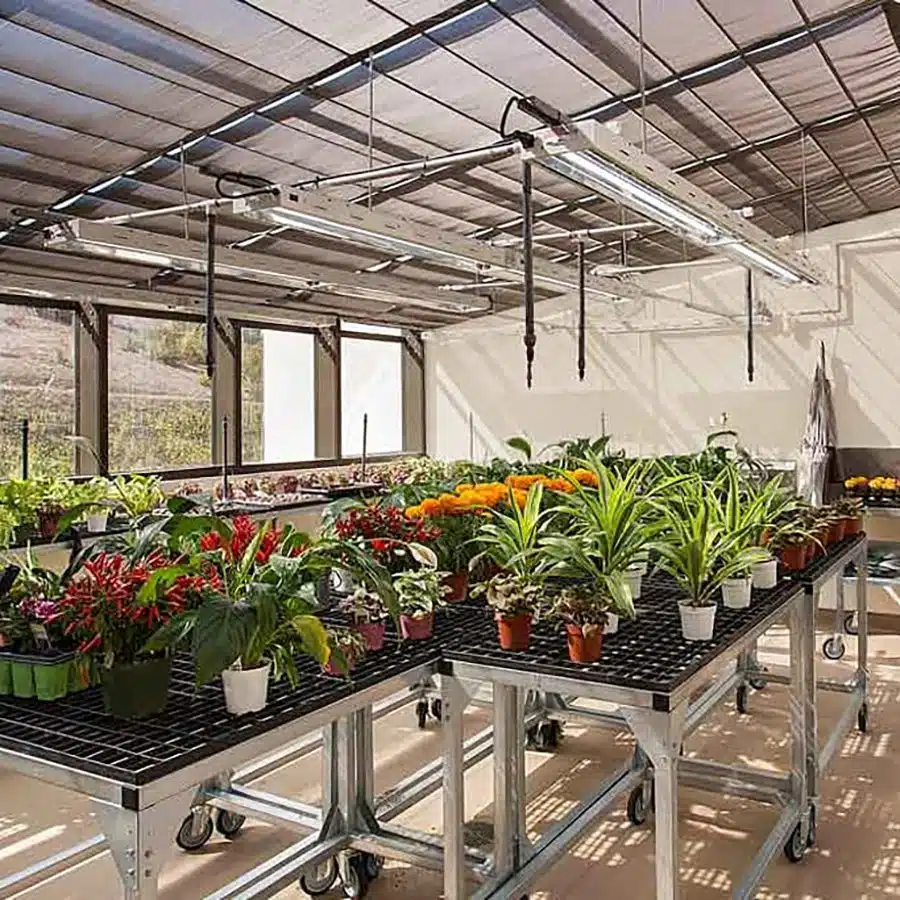
Custom roof shading solves this with systems engineered for the specific pitch and dimensions of the glass. Interior roof blinds—pleated, pinoleum, or tensioned fabric panels—run on side tracks or tensioned cables that hold the fabric flat against the slope so it can’t sag or fall. Exterior roof shades mount above the glass on guided tracks, intercepting heat before it enters and offering the strongest cooling effect. Either way, the system has to be made to measure; there’s no off-the-shelf option that fits a sloped glass roof correctly.
Manual vs. Motorized Operation
Custom sunshades operate either by hand or by motor, and the choice has real practical consequences in a glass room.
Manual systems use cords, cranks, or wands and cost less. They work well for shades you can easily reach, but they become impractical across many large panels or anywhere on the roof.
Motorized systems use a small motor in the headrail, controlled by remote, wall switch, or smartphone app. In a sunroom with numerous panels and roof glass you can’t reach, motorization is what makes the shades actually get used. Smart systems go further—linking to a home automation platform and adjusting automatically based on time of day, sun position, or interior temperature, so the room shades itself before it overheats. Motorized roof shades in particular are close to essential, since manually operating shading 12 feet overhead isn’t realistic.
Why Custom Sunshades Are Worth It
The case for custom shading is simple: a sunroom’s glass is its whole appeal, but uncontrolled, that same glass creates glare, fading, and summer heat that can make the room unusable when you most want it. Custom sunshades give you control over all of that—tuned to your room’s exact shape, exposure, and the way you use it—without giving up the light and views that make the space special.
The right system depends on your glass layout, your climate, and which problem you’re solving most. If you’d like help designing shading for a sunroom or solarium—including the roof glass that stock products can’t handle—the team at Sunshine Rooms can recommend a custom solution built to fit your space and perform season after season.
Related Posts

We Like to Hear From You!
We service and support the products we manufacture and install. If you need assistance with
our products or those of another sunroom manufacturer, contact us!