
If you’ve been researching sunroom styles, you’ve probably come across terms like studio, shed-roof, and lean-to—sometimes used interchangeably, sometimes not. It can be confusing. But a lean-to sunroom is actually one of the simplest and most practical sunroom designs available, and understanding how it works will help you decide whether it’s the right choice for your project.
Here’s a clear look at what makes a lean-to sunroom different from other styles, where it shines, and where its limitations show up.
The Basic Structure
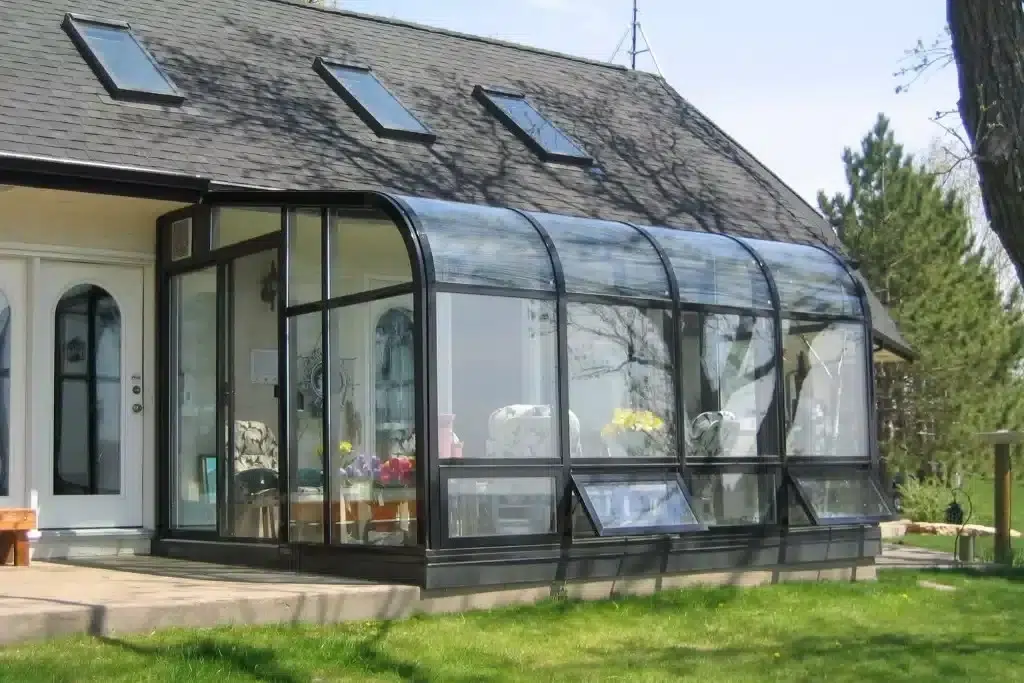
A lean-to sunroom features a single-sloped roof that attaches at a higher point on your existing house wall and slopes downward to an outer wall. There’s no peak, no ridge, and no complex roofline—just one clean plane of roof angling away from the house.
The high side of the roof connects to your home through a ledger board—a horizontal structural member bolted into the house’s framing. The low side rests on the sunroom’s outer wall. This creates a straightforward structure with fewer framing components than peaked designs.
You’ll hear this style called by several names depending on the manufacturer or contractor:
- Studio sunroom — the most common term among major manufacturers
- Shed-roof sunroom — emphasizes the roof geometry
- Single-slope sunroom — descriptive and self-explanatory
- Straight-eave sunroom — used in some product catalogs
These all refer to the same structure. The terms are interchangeable.
How a Lean-To Differs from Other Sunroom Styles
Understanding the differences helps you choose the right design for your situation.
Lean-To vs. Gable (Cathedral)
A gable sunroom has two roof planes that meet at a center ridge, creating an A-frame or peaked ceiling. This gives the room a vaulted, cathedral-like feel with more interior volume and visual drama. A lean-to has a single slope—simpler, lower-profile, and less expensive, but without that open, soaring ceiling effect.
In the sunroom industry, “gable” and “cathedral” are often used interchangeably because a gable roof naturally creates a cathedral ceiling inside. Some manufacturers distinguish them as separate products, but structurally they share the same peaked roof form.
A gable roof typically adds $3,000-$4,000 to the project cost compared to a lean-to of the same size and specifications.
Lean-To vs. Flat Roof
A flat roof has little to no slope—technically 1/4:12 or less. It provides uniform ceiling height but creates drainage challenges. Water can pond on a flat roof if drainage isn’t precisely engineered, leading to leaks and structural stress over time. A lean-to’s defined slope (typically 3:12 to 6:12) drains water naturally toward one drip edge, functioning like a standard sloped roof. This makes lean-to designs inherently more reliable for water management.
Lean-To vs. Solarium
A solarium features predominantly glass walls and roof panels, creating a fully transparent enclosure. Lean-to sunrooms typically have a solid or partially solid roof with insulated panels, offering better thermal performance and easier climate control. Solariums cost significantly more—$300-$800 per square foot compared to $150-$300 for a standard sunroom—and are harder to heat and cool efficiently.
The Advantages of a Lean-To Design
Several practical benefits make this the most popular entry-level sunroom style.
Lower Cost
The single-slope roof requires fewer structural components than a gable—no ridge board, no opposing rafter pairs, no complex ceiling framing. This translates directly to lower material and labor costs. Expect to save $3,000-$4,000 compared to an equivalent gable sunroom, making lean-to designs the most affordable peaked-style option after basic porch enclosures.
Simpler Construction
Fewer framing components mean faster installation and fewer potential failure points. A single roof plane has fewer seams and penetrations than a gable, reducing leak risk over the life of the structure. The attachment to the house is straightforward—one ledger board connection with continuous metal flashing—versus the more complex intersection a gable roof creates.
Reliable Water Drainage
Water flows in one direction, toward one drip edge. There’s no valley, no ridge junction, and no interior drainage system to maintain. This simplicity is a genuine long-term maintenance advantage over both flat-roof and some gable configurations.
Versatile Attachment
Lean-to sunrooms work well on both single-story and two-story homes. On a single-story home, the ledger typically attaches just below the existing roofline or fascia. On a two-story home, it attaches to the first-floor wall section, with plenty of wall height above to accommodate a comfortable roof slope.
The Limitations You Should Know
Every design involves trade-offs. Here’s where the lean-to falls short.
Headroom on the Low Side
This is the most significant limitation. Because the roof slopes from the house wall down to the outer wall, the ceiling gets progressively lower as you move away from the house. How much lower depends on the roof pitch and the room’s depth.
A practical example: if the ledger board attaches at 9 feet on the house wall and the roof slopes at 3:12 over a 12-foot depth, the outer wall height drops to approximately 6 feet. Most building codes require a minimum ceiling height of 7 feet for habitable space, which means you’d either need to raise the ledger attachment point higher or reduce the room’s depth.
This geometric constraint means deeper lean-to sunrooms require either a higher attachment point on the house, a shallower roof pitch, or acceptance of limited headroom near the outer wall.
Depth Constraints
Standard dimensional lumber rafters (2×8 or 2×10) can span 12-16 feet without interior support. Beyond that, you’ll need engineered lumber or posts, adding cost and complexity. Combined with the headroom issue, most lean-to sunrooms are practical at depths of 8-16 feet.
Aesthetic Simplicity
A lean-to sunroom doesn’t provide the dramatic vaulted ceiling of a gable design. From the exterior, it reads as a simpler addition. This works well with contemporary, craftsman, or modern home styles but may look understated on formal traditional or colonial homes where a peaked roofline would integrate more naturally.
When a Lean-To Sunroom Is the Right Choice
This design makes the most sense when:
- Budget is a priority and the $3,000-$4,000 gable premium isn’t justified
- Your home has a clean wall section at the right height for a ledger attachment
- The planned depth is 8-14 feet—the sweet spot where headroom and structural span align comfortably
- Contemporary or craftsman aesthetics match your home’s style
- You’re in a mild to moderate climate where pitch requirements for snow management don’t compress the outer wall height further
Consider a gable or cathedral design instead when you want a vaulted ceiling feel, maximum interior volume, a deeper room (16+ feet), or a more traditionally architectural exterior appearance.
What Does a Lean-To Sunroom Cost?
Lean-to sunrooms fall within the general sunroom cost range, sitting at the lower end due to their simpler construction.
| Project Type | Typical Cost Range |
| Prefab lean-to kit (polycarbonate panels) | $3,000-$15,000 |
| Custom-built lean-to (three-season) | $15,000-$40,000 |
| Custom-built lean-to (four-season) | $25,000-$60,000 |
| General sunroom cost per sq ft (custom) | $150-$300 |
| General sunroom cost per sq ft (prefab) | $100-$150 |
An important distinction: prefab polycarbonate kits sold through home improvement retailers are a fundamentally different product than custom-built contractor sunrooms. The materials, insulation, structural integrity, and longevity are not comparable. If you’re comparing quotes, make sure you’re comparing the same category.
Simple Design, Smart Choice
A lean-to sunroom strips away the complexity of peaked rooflines and delivers a practical, cost-effective space filled with natural light. Its simplicity is its strength—fewer components, fewer leak points, lower cost, and faster construction.
The key is understanding the headroom and depth trade-offs before you commit. If the geometry works for your home and your planned room size, a lean-to can deliver everything you want from a sunroom at a price that makes the project easier to justify.
Have questions about whether a lean-to design is right for your home? The team at Sunshine Rooms can help you evaluate your options and find the sunroom style that fits your space, budget, and goals.
Related Posts


We Like to Hear From You!
We service and support the products we manufacture and install. If you need assistance with
our products or those of another sunroom manufacturer, contact us!