
If you live in a region that gets real winters, this question matters before you invest in a pool enclosure. A structure that handles Florida rain just fine could fail catastrophically under a foot of wet snow in Michigan or Colorado. The answer depends entirely on how the enclosure is engineered, what materials it uses, and whether it was designed for your specific snow load conditions.
Here’s what determines whether a pool enclosure can handle heavy snow—and what happens when one can’t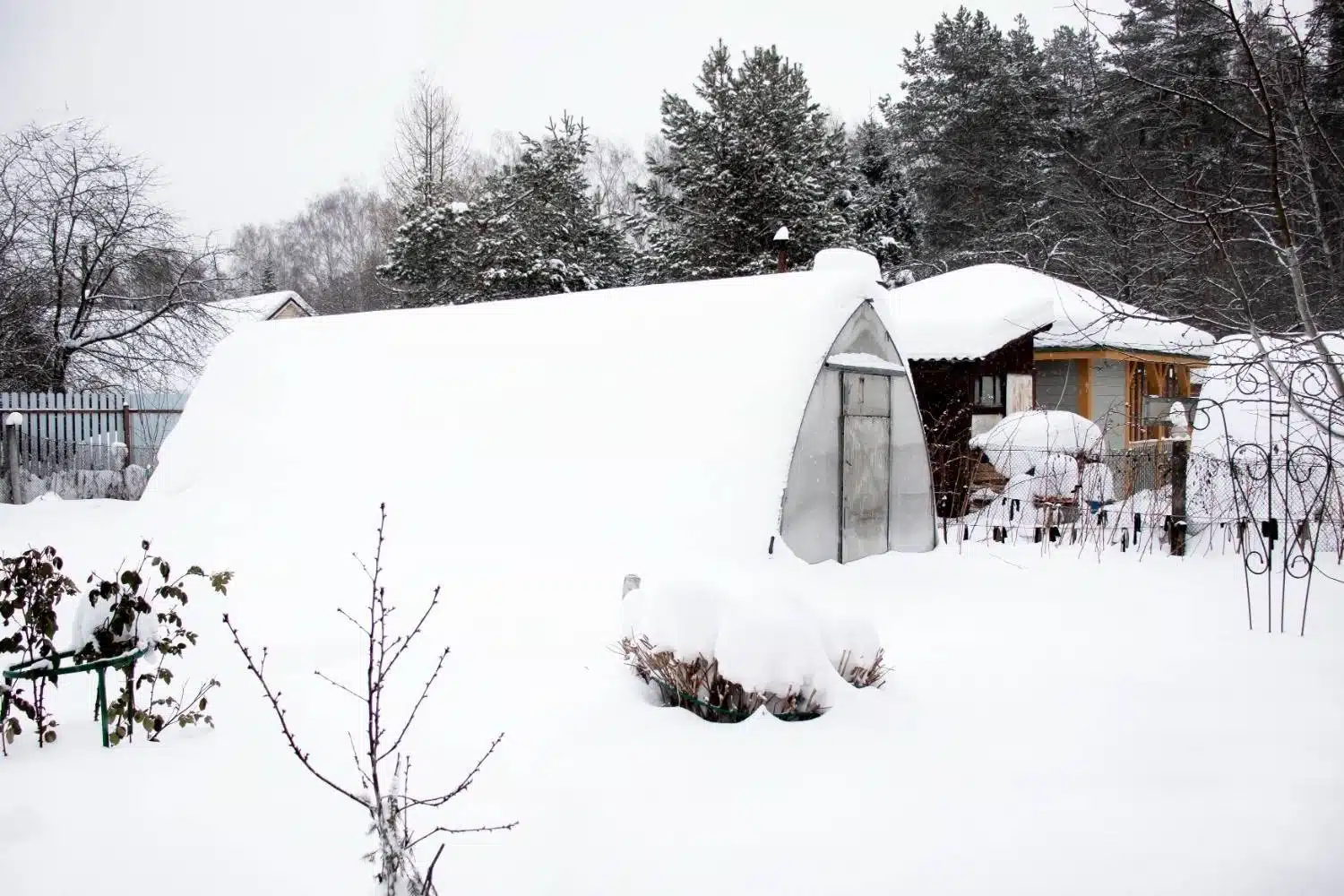
Snow Load Ratings Are the Starting Point
Every structural building component in the United States is designed to handle a specific snow load—the weight of accumulated snow the structure must support without failing. This is measured in pounds per square foot (psf) and varies dramatically by location.
How snow load is determined:
The ground snow load for your area is established by ASCE 7 (the standard used by building codes nationwide) and ranges from 0 psf in southern Florida to over 100 psf in mountain regions of Colorado, Utah, and the Sierra Nevada. Your local building department can tell you the exact ground snow load for your property.
The roof snow load—what your pool enclosure actually needs to handle—is calculated from the ground snow load using factors for roof slope, exposure, thermal conditions, and importance. A heated pool enclosure in an open area will accumulate less snow than an unheated structure sheltered by trees and adjacent buildings, because heat from the pool promotes melting and open exposure allows wind to clear snow.
The critical point: A pool enclosure must be engineered to meet or exceed the roof snow load for your specific location. There is no universal “snow-rated” or “snow-proof” designation. An enclosure rated for 20 psf is adequate in much of the mid-Atlantic but dangerously undersized for upstate New York or the Rocky Mountain region.
How Snow Load Translates to Real Weight
Snow is heavier than most people realize, and its weight varies enormously depending on moisture content.
| Snow Type | Weight Per Cubic Foot | Weight of 12 Inches on 1 sq ft |
| Fresh, dry powder | 3-5 lbs | 3-5 lbs/sq ft |
| Typical fresh snowfall | 5-10 lbs | 5-10 lbs/sq ft |
| Settled, compacted snow | 10-20 lbs | 10-20 lbs/sq ft |
| Wet, heavy snow | 15-30 lbs | 15-30 lbs/sq ft |
| Ice or refrozen snow | 40-57 lbs | 40-57 lbs/sq ft |
A single heavy, wet snowfall of 12 inches can deposit 15-30 psf on a flat roof—and if temperatures drop before it melts, that snow compresses and may be topped by additional accumulation. Multiple storms without melting between them create a cumulative load that can exceed the design capacity of an enclosure not built for your climate.
This is why location-specific engineering matters. A pool enclosure rated for 30 psf handles a foot of wet snow comfortably. That same enclosure under two feet of compacted snow plus an ice layer could be carrying 50-70 psf—well beyond its capacity.
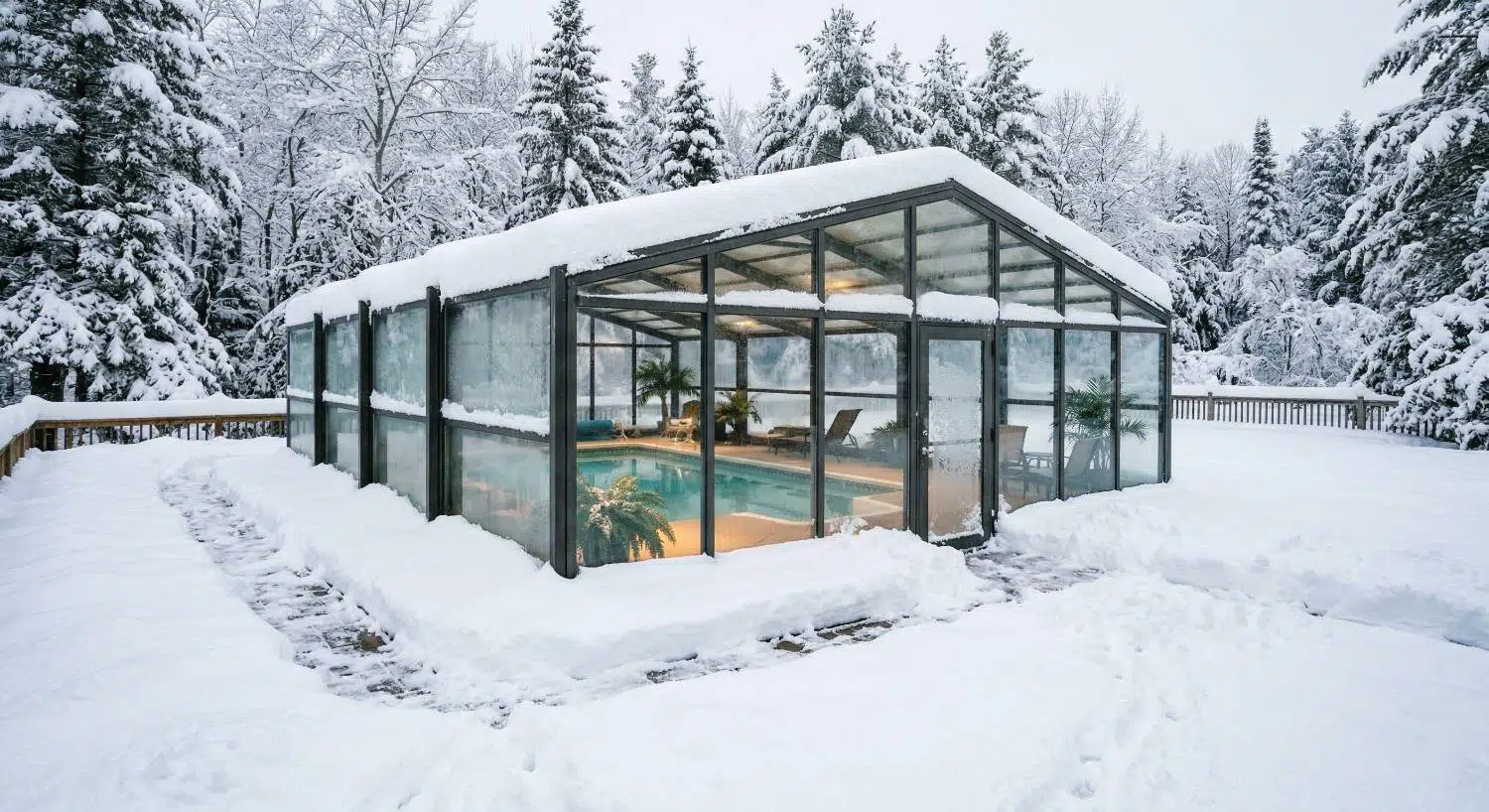
Roof Pitch and Shape Make a Difference
How snow behaves on a roof depends heavily on the roof’s slope and geometry.
Steeper pitches shed snow faster. A roof pitched at 6:12 or steeper allows snow to slide off before it accumulates to dangerous levels. Shallow-pitched or flat roofs hold snow in place, allowing it to compact and gain weight over time. Most pool enclosures have relatively low-pitch roofs compared to residential homes, which means snow tends to stay rather than shed.
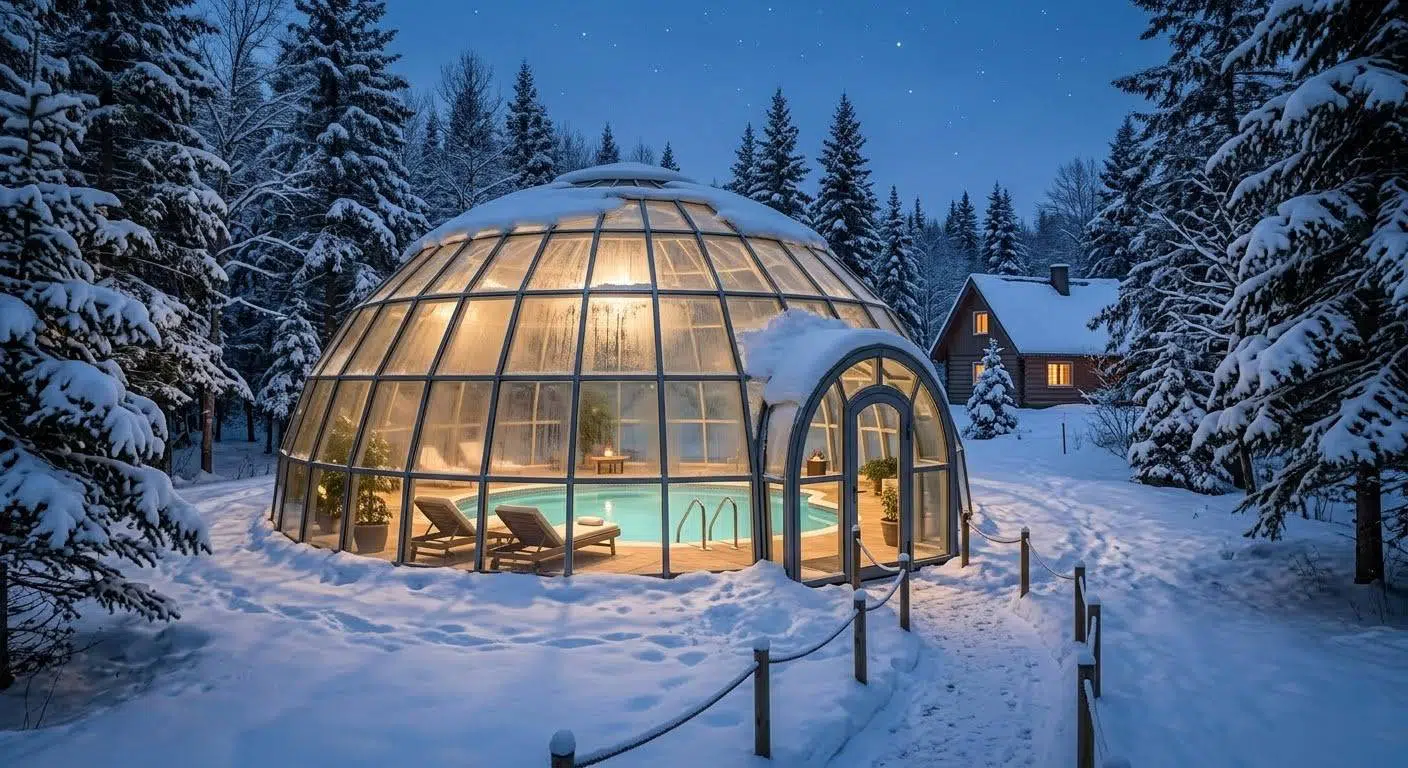
Curved and domed enclosures perform better than flat-topped designs in snow regions. The curved profile encourages snow to slide off the sides and distributes the remaining load more evenly across the structure. This is one reason retractable and low-profile dome enclosures are popular in northern climates—the shape works with gravity rather than against it.
Valleys and flat sections are danger zones. Any area where the roof creates a pocket—valleys between sections, flat transitions between slopes, or areas where the enclosure meets the house wall—will accumulate disproportionate snow. These points experience loads significantly higher than the average across the roof.
Material Strength Under Snow Load
The framing material and glazing type both affect how a pool enclosure performs under snow.
Aluminum framing is the standard for pool enclosures. Structural-grade aluminum (typically 6061-T6 or 6063-T5 alloy) offers excellent strength-to-weight ratio and corrosion resistance. However, aluminum framing designed for screen enclosures in warm climates is far lighter-gauge than what’s needed for snow regions. A snow-rated aluminum enclosure uses heavier extrusions, closer rafter spacing, and reinforced connection points to handle the additional load.
Steel framing provides higher strength for the same member size and is used in some heavy-duty pool enclosure systems designed specifically for snow country. Steel handles concentrated point loads better than aluminum, which matters when snow drifts create uneven loading patterns.
Polycarbonate panels are the most common glazing for pool enclosures in snow regions. Multi-wall polycarbonate is lightweight (reducing the dead load the structure must carry in addition to snow), impact-resistant, and flexes under load rather than shattering. Its 200-250 times greater impact resistance compared to glass makes it significantly safer if a panel does fail under extreme load—it deforms rather than sending shards into the pool area.
Glass panels are heavier, adding to the total load the structure must support before any snow accumulates. Tempered glass handles distributed loads well but can fail suddenly under concentrated point loads from ice formations. Laminated glass holds together when cracked, providing a safety advantage, but its weight means the structural frame must be designed with a lower remaining capacity for snow.
What Happens When Snow Load Is Exceeded
When snow accumulation exceeds the design capacity of a pool enclosure, failure can happen in several ways.
Progressive deformation: Aluminum members begin to bend under sustained overload. The enclosure may sag visibly before catastrophic failure, giving some warning. However, once bending starts, the structure weakens progressively—a member that has permanently deformed has lost structural capacity and won’t recover when the snow melts.
Connection failure: Bolts, screws, and brackets at frame joints are often the first components to fail. A single connection giving way redistributes load to adjacent connections, which may then cascade.
Panel blowout: Glazing panels can pop out of their frames or crack under excessive load, especially at the center of large spans where deflection is greatest.
Catastrophic collapse: In the worst case, the entire structure or a significant section gives way at once. This is most dangerous because it happens suddenly and can drop heavy framing and panels into the pool area.
The most common failure scenario isn’t a single massive storm—it’s cumulative loading from multiple storms without clearing between them, combined with ice formation that adds concentrated weight.
How to Protect Your Pool Enclosure in Winter
Even a properly engineered enclosure benefits from active winter maintenance.
Monitor accumulation. After every significant snowfall, visually assess how much snow is sitting on the enclosure. If your enclosure is rated for 30 psf and you estimate 15-20 psf has accumulated with more snow forecast, it’s time to act.
Remove snow carefully. Use a soft roof rake or push broom to clear snow from accessible panels. Never use metal shovels, ice picks, or sharp tools—these damage glazing panels and frame finishes. Work from the ground whenever possible. Never climb onto a pool enclosure roof to clear snow.
Prevent ice dams. Heat-trace cables along the gutter line and at valleys prevent meltwater from refreezing at the roof edge. Ice dams concentrate heavy ice loads at the weakest points of the structure—the eaves and connections.
Keep the pool heated. A heated pool radiates warmth upward through the enclosure, promoting snowmelt from below. This passive effect reduces accumulation on glass or polycarbonate panels. It won’t prevent all buildup, but it meaningfully reduces the load between manual clearings.
Inspect after winter. Once spring arrives, inspect all structural connections, glazing seals, and frame members for signs of stress—bent or bowed members, loose fasteners, cracked seals, or panel displacement. Address any damage before the next winter season.
Choosing an Enclosure Built for Your Climate
A pool enclosure absolutely can withstand heavy snow—but only if it’s engineered for the snow loads specific to your location. The difference between a warm-climate screen enclosure and a snow-rated structural enclosure is substantial in terms of framing gauge, rafter spacing, connection hardware, and overall engineering.
If you’re in a region that sees regular snowfall, the non-negotiables are: a structure engineered to your local ground snow load, appropriate roof pitch or curvature to promote shedding, and a commitment to monitoring and clearing snow during heavy accumulation events.
Planning a pool enclosure in a snow region? The team at Sunshine Rooms engineers every enclosure for the specific load conditions at your property. Reach out to discuss what your climate requires and how to design an enclosure that performs safely through every season.
Related Posts

We Like to Hear From You!
We service and support the products we manufacture and install. If you need assistance with
our products or those of another sunroom manufacturer, contact us!